Wednesday, December 22, 2021
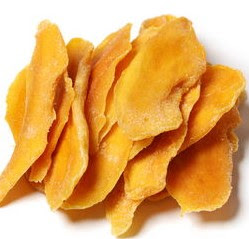
Dried mangoes
Mango has a high perishability and a seasonal availability, so, in a dried form, its availability over a longer period of time increases, which potentially contributes to increased fruit consumption. Dried mango products (slices or flakes) are generally prepared from ripe mangoes and dehydrated using a variety of methods including solar, hot-air cabinet, vacuum, spray, or freeze dryers.
Postharvest losses of mango fruit in a number of developing countries in Africa and Asia have been estimated to be as high as over 50%, especially during the main harvest season. Drying mangoes is an ideal value-added opportunity for processors in many developing countries, as processing requirements are relatively non-capital intensive.
These dried fruit pieces retain some softness, and the drying process generally provides fairly uniform preservation.
Dried mango slices or pieces, most often sold under the organic label, generally produced using a more or less artisanal processing technique. These products have an often-heterogeneous quality in terms of shape and coloration, as well as a limited shelf life.
Dried mango is a ready to eat healthy snack for all age groups. Dried mango also tastes delicious when it is soaked in water, juices and yogurt.
There are three main types that can be distinguished:
*Sweetened dried mangoes
*Conventional dried mangoes
*Natural dried mangoes
Dried mangoes
Thursday, June 12, 2008
Mangoes and Its Species
Mangoes belong to the genus of Mangifera. There are 1000 named mango species. Among them
- Mangifera acutigemma
- Mangifera altissima
- Mangifera andamanica
- Mangifera applanata
- Mangifera austro-indica
- Mangifera austro-yunnanensis
- Mangifera blommesteinii
- Mangifera bullata
- Mangifera caesia
- Mangifera camptosperma
- Mangifera campnospermoides
- Mangifera casturi
- Mangifera collina
- Mangifera decandra'
- Mangifera dewildei
- Mangifera dongnaiensis
- Mangifera flava
- Mangifera foetida
- Mangifera gedebe
- Mangifera gracilipes
- Mangifera griffithii
- Mangifera hiemalis
- Mangifera indica
- Mangifera kemanga
- Mangifera lalijiwa
- Mangifera laurina
- Mangifera longipes
- Mangifera macrocarpa
- Mangifera magnifica
- Mangifera mekongensis
- Mangifera minutifolia
- Mangifera monandra
- Mangifera nicobarica
- Mangifera odorata
- Mangifera orophila
- Mangifera pajang
- Mangifera paludosa
- Mangifera parvifolia
- Mangifera pedicellata
- Mangifera pentandra
- Mangifera persiciformis
- Mangifera quadrifida
- Mangifera rubropetala
- Mangifera rufocostata
- Mangifera siamensis
- Mangifera similis
- Mangifera sumbawaensis
- Mangifera superba
- Mangifera swintonioides
- Mangifera sylvatica
- Mangifera taipa
- Mangifera torquenda
- Mangifera transversalis
- Mangifera zeylanica
Most of the fruit trees that are commonly known as mangos belong to the species Mangifera indica. The other edible Mangifera species generally have lower quality fruits and are commonly referred to as wild mangos.
The plant can reach 35 – 40 m in height, with a crown radius of 10 m. The leaves are ever green and dark green when matured.
The ripe fruit is variable in size and color, such as yellow, orange, and red or purple. Often red on the side facing the sun and yellow were shaded, a mango that us green usually indicates unripe fruit, but this depends on the cultivar.
Mango flowers are visited by fruit bats, flies, wasps, wild bees, butterflies, moths, beetles, ants and various bugs seeking the nectar and some transfer the pollen but a certain amount of self-pollination also occurs. Honeybees do not especially favor mango flowers and it has been found that effective pollination by honeybees would require 3 to 6 colonies per acre (6-12 per ha). Many of the unpollinated flowers are shed or fail to set fruit, or the fruit is set but is shed when very young. Heavy rains wash off pollen and thus prevent fruit setting. Some cultivars tend to produce a high percentage of small fruits without a fully developed seed because of unfavorable weather during the fruit-setting period.
Mangoes and Its Species
Popular Posts
-
History and Origin of Mango The mango has been known in India since very early times. It is referred to in Sanskrit literature as Amra and h...
-
This tropical fruit is high in vitamin C. Mango fruits contain 10-20 percent sugar and are important source of vitamin A. They have a rich,...
-
Uses of Mango and Nutritional Composition Mango is commonly eaten fresh and depending upon the cultivar may be consumed at an immature (unri...
-
The mango is believed to have been discovered as long as five to six thousand years in eastern India, Thailand, Myanmar, the Andaman Islands...