The Keitt Mango, commonly found in commercial markets, is a substantial fruit typically weighing between 500 and 750 grams.
Upon reaching full ripeness, its skin adopts a lively green hue, and the golden-orange flesh becomes tender to the touch. The flesh is firm, devoid of fibers, and features a slightly lower sugar content compared to other mango varieties.
Thanks to its fiber-free composition, the Keitt Mango exhibits a smooth texture that enhances its honey-sweet flavor with subtle notes of lemon. While frequently enjoyed fresh and by hand, this mango is versatile in various culinary applications, including sorbets, cocktails, smoothies, fruit salads, and even savory rice dishes.
It is noteworthy that the Keitt Mango retains more vitamin C as it ripens, distinguishing it from certain other mango varieties that may see a decrease in vitamin C potency while simultaneously witnessing an increase in levels of vitamin A during the ripening process.
Keitt Mango: Size, Taste, Usage
Showing posts with label Keitt mango. Show all posts
Showing posts with label Keitt mango. Show all posts
Wednesday, January 17, 2024
Tuesday, July 18, 2023
Mango Production in China
Mangoes have become the top choice for domestic tropical fruit sales in the market, owing to their smooth, juicy, and delectable pulp, combined with their high nutritional value. Mangoes are cultivated in approximately 110 countries and regions across the globe.
China has experienced a remarkable surge in mango production, driven by the strong demand within the domestic market. Despite being a significant consumer of mangoes, China's own production remains relatively smaller. The country primarily relies on imports of fresh mango fruit from the Philippines, Thailand, Vietnam, Indonesia, Myanmar, Australia, India, Peru, and Pakistan. While China does have native wild mango species, the majority of mango cultivars originate from abroad, including varieties like Carabao, Nang Klangwan, Dashehari, Okrong, Irwin, Haden, among others.
Mango cultivation in China has a long history dating back a thousand years. However, large-scale commercial production only began in the 1960s, with significant expansion occurring during the 1980s. The key regions for commercial cultivation are found in southern China, covering Guangxi, Yunnan, Hainan, Sichuan, Guangdong, Guizhou, and Fujian.
Among these regions, Guangxi, Yunnan, and Hainan stand out as the largest production areas, accounting for 78.66% of the total cultivated area and 78.33% of the total mango output, respectively.
The Keitt variety holds unparalleled popularity among Chinese consumers. Recognizable by their oblong shape and pale to dark green skin, occasionally with a yellow blush, Keitt Mangoes can be challenging to judge for ripeness based on color alone. The best method to determine if these sizable mangoes are ripe is to feel them - the skin should give slightly to the touch. Even then, the mangoes might require a few more days to fully ripen.
Mango Production in China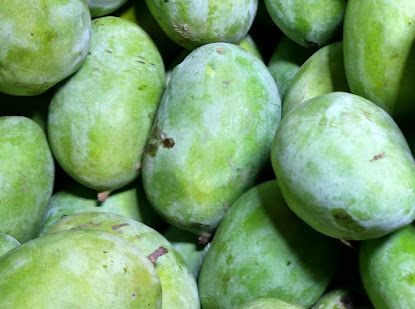
China has experienced a remarkable surge in mango production, driven by the strong demand within the domestic market. Despite being a significant consumer of mangoes, China's own production remains relatively smaller. The country primarily relies on imports of fresh mango fruit from the Philippines, Thailand, Vietnam, Indonesia, Myanmar, Australia, India, Peru, and Pakistan. While China does have native wild mango species, the majority of mango cultivars originate from abroad, including varieties like Carabao, Nang Klangwan, Dashehari, Okrong, Irwin, Haden, among others.
Mango cultivation in China has a long history dating back a thousand years. However, large-scale commercial production only began in the 1960s, with significant expansion occurring during the 1980s. The key regions for commercial cultivation are found in southern China, covering Guangxi, Yunnan, Hainan, Sichuan, Guangdong, Guizhou, and Fujian.
Among these regions, Guangxi, Yunnan, and Hainan stand out as the largest production areas, accounting for 78.66% of the total cultivated area and 78.33% of the total mango output, respectively.
The Keitt variety holds unparalleled popularity among Chinese consumers. Recognizable by their oblong shape and pale to dark green skin, occasionally with a yellow blush, Keitt Mangoes can be challenging to judge for ripeness based on color alone. The best method to determine if these sizable mangoes are ripe is to feel them - the skin should give slightly to the touch. Even then, the mangoes might require a few more days to fully ripen.
Mango Production in China


Subscribe to:
Posts (Atom)
Popular Posts
-
 History and Origin of Mango The mango has been known in India since very early times. It is referred to in Sanskrit literature as Amra and h...
-
 This tropical fruit is high in vitamin C. Mango fruits contain 10-20 percent sugar and are important source of vitamin A. They have a rich,...
-
 Uses of Mango and Nutritional Composition Mango is commonly eaten fresh and depending upon the cultivar may be consumed at an immature (unri...
-
 The mango is believed to have been discovered as long as five to six thousand years in eastern India, Thailand, Myanmar, the Andaman Islands...

