The Sala mango, known for its unique flavor and appealing characteristics, is a prized variety in many regions where it is cultivated. This mango, often recognized by its distinctive appearance and taste, has several attributes that set it apart from other mango varieties, making it a favorite among consumers and growers alike.
The Sala mango typically boasts a vibrant, golden-yellow skin with a slight blush of red, creating an eye-catching aesthetic. Its deep orange flesh is exceptionally juicy and completely fiberless, offering a smooth, velvety texture that enhances the eating experience. This mango’s standout feature is its intensely sweet and aromatic flavor, with hints of tropical fruits such as pineapple, citrus, and a subtle floral undertone, resulting in a refreshingly delightful taste.
This variety is cultivated primarily in Southeast Asia, particularly in Thailand and the Philippines, where it thrives in the warm, tropical climate. Farmers favor the Sala mango for its consistent high yield and relatively short maturation period, making it a profitable crop. It is often grown using advanced horticultural techniques such as grafting, which helps maintain the superior quality of the fruit. Additionally, ongoing research and development in mango cultivation have improved disease resistance, further enhancing the reliability of Sala mango production.
The Sala mango tree itself is relatively hardy and well-suited to tropical and subtropical climates. It demonstrates vigorous growth and produces abundant fruit during the peak mango season. Notably, the tree has a strong resistance to common mango diseases, including anthracnose and powdery mildew, reducing the need for extensive chemical treatments and making it an environmentally sustainable option for farmers.
Beyond its fresh consumption, the Sala mango is widely used in culinary applications. It is a key ingredient in smoothies, desserts, salads, and even savory dishes. In regions where it is grown, Sala mangoes are often processed into dried mango slices, juices, and jams, expanding their market reach globally.
With its exquisite taste, appealing texture, and adaptability, the Sala mango continues to gain popularity in both domestic and international markets, cementing its status as a premium mango variety.
Sala Mango: A Premium Tropical Delight
Showing posts with label characteristic. Show all posts
Showing posts with label characteristic. Show all posts
Monday, February 10, 2025
Sunday, November 10, 2024
Sindhri Mango: Pakistan’s Iconic King of Mangoes
The Sindhri mango, famously known as the “king of mangoes,” stands as a prized fruit from Pakistan’s Sindh region, recognized globally for its unparalleled sweetness, rich aroma, and vivid yellow hue. This variety has garnered a devoted following among mango aficionados worldwide, particularly for its unique blend of flavors that combine honeyed sweetness with subtle tartness, leaving a memorable taste experience. A flagship of Pakistani mango production, the Sindhri holds its own among other varieties due to its exceptional quality, which has elevated it to international fame.
Typically harvested between May and June, Sindhri mangoes herald the start of Pakistan’s mango season. These mangoes are distinguished by their large, elongated shape and their smooth, blemish-free skin. With a weight that often reaches up to 500 grams or more, a Sindhri mango can be a meal on its own. The flesh is notably fiberless, creamy, and juicy, providing a luxurious, melt-in-the-mouth sensation, which makes it perfect for fresh consumption, mango smoothies, and desserts. In addition to its delightful taste, the Sindhri is nutritionally rich, packed with essential vitamins A and C, antioxidants, and dietary fiber, contributing to numerous health benefits.
The Sindhri’s premium quality stems from the ideal growing conditions in Sindh. The region's fertile soil, coupled with a warm, dry climate, fosters optimal growth. The long hours of sunshine and the nutrient-rich Indus River basin soil impart the Sindhri mango’s trademark sweetness and vibrant color. Farmers in Sindh utilize a blend of traditional farming techniques passed down through generations, along with modern agricultural advancements, to increase productivity while maintaining the fruit’s superior quality.
Sindhri mangoes are cherished in domestic and international markets, with significant exports to the Middle East, Europe, North America, and beyond. Pakistan is one of the world’s leading mango exporters, and the Sindhri contributes significantly to this global reputation. In international markets, it stands out as a premium choice, favored for its flavor, texture, and aroma, which often command higher prices.
Beyond its status as a delicious treat, the Sindhri mango holds deep cultural importance in Pakistan, symbolizing hospitality and generosity. It is frequently gifted during holidays and gatherings, embodying a sense of pride and cultural heritage. The Sindhri mango thus represents the spirit of Pakistani agriculture and the cultural richness of Sindh, making it not only a beloved fruit but also a cultural icon, connecting communities across borders.
Sindhri Mango: Pakistan’s Iconic King of Mangoes
Typically harvested between May and June, Sindhri mangoes herald the start of Pakistan’s mango season. These mangoes are distinguished by their large, elongated shape and their smooth, blemish-free skin. With a weight that often reaches up to 500 grams or more, a Sindhri mango can be a meal on its own. The flesh is notably fiberless, creamy, and juicy, providing a luxurious, melt-in-the-mouth sensation, which makes it perfect for fresh consumption, mango smoothies, and desserts. In addition to its delightful taste, the Sindhri is nutritionally rich, packed with essential vitamins A and C, antioxidants, and dietary fiber, contributing to numerous health benefits.
The Sindhri’s premium quality stems from the ideal growing conditions in Sindh. The region's fertile soil, coupled with a warm, dry climate, fosters optimal growth. The long hours of sunshine and the nutrient-rich Indus River basin soil impart the Sindhri mango’s trademark sweetness and vibrant color. Farmers in Sindh utilize a blend of traditional farming techniques passed down through generations, along with modern agricultural advancements, to increase productivity while maintaining the fruit’s superior quality.
Sindhri mangoes are cherished in domestic and international markets, with significant exports to the Middle East, Europe, North America, and beyond. Pakistan is one of the world’s leading mango exporters, and the Sindhri contributes significantly to this global reputation. In international markets, it stands out as a premium choice, favored for its flavor, texture, and aroma, which often command higher prices.
Beyond its status as a delicious treat, the Sindhri mango holds deep cultural importance in Pakistan, symbolizing hospitality and generosity. It is frequently gifted during holidays and gatherings, embodying a sense of pride and cultural heritage. The Sindhri mango thus represents the spirit of Pakistani agriculture and the cultural richness of Sindh, making it not only a beloved fruit but also a cultural icon, connecting communities across borders.
Sindhri Mango: Pakistan’s Iconic King of Mangoes


Sunday, April 16, 2023
Characteristics of mango leaves
Mango leaves are the foliage of an evergreen tree belonging to the Anacardiaceae family. The leaves grow on large trees that can reach 15 to 30 meters in height and thrive in tropical to subtropical regions worldwide. Leaves droop like ribbons on slender petioles, borne mainly in rosettes at the tips of the branches and numerous twigs. New leaves appear periodically and irregularly on a few branches at a time.
First, they are yellowish, pink, deep-rose or wine-red and in time, they become dark-green and glossy. Full-grown leaves may be 10-32 cm long. Hundreds, perhaps even up to 4,000, small, yellowish or reddish flowers are borne in profuse, showy, erect, pyramidal, branched clusters. 25% to 98% male, the rest hermaphroditic.
Being rich in antioxidants, these leaves are loaded with anti-inflammatory properties. It also has anti-microbial properties. As per studies, these leaves prevent degenerating cells and cell damage.
Mango leaves are rich in vitamins like vitamin C, vitamin A, and vitamin B. It contains other compounds like steroids, alkaloids, riboflavin, Thiamin, phenolic, beta-carotene, flavonoids, etc.
According to Ayurveda and traditional Chinese medicine, mango leaves are used for thousands of years now for their healing properties. Traditionally, mango leaves have been used for natural healing applications such as treating diarrhea, dysentery, gastrointestinal tract disorders, scurvy, typhoid fever, sore throat, and as a febrifuge.
The mango leaves are good for all kinds of respiratory problems. It is especially useful for people suffering from colds, bronchitis and asthma.
Characteristics of mango leaves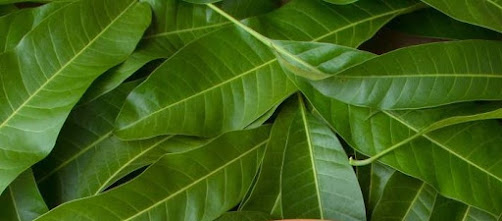
First, they are yellowish, pink, deep-rose or wine-red and in time, they become dark-green and glossy. Full-grown leaves may be 10-32 cm long. Hundreds, perhaps even up to 4,000, small, yellowish or reddish flowers are borne in profuse, showy, erect, pyramidal, branched clusters. 25% to 98% male, the rest hermaphroditic.
Being rich in antioxidants, these leaves are loaded with anti-inflammatory properties. It also has anti-microbial properties. As per studies, these leaves prevent degenerating cells and cell damage.
Mango leaves are rich in vitamins like vitamin C, vitamin A, and vitamin B. It contains other compounds like steroids, alkaloids, riboflavin, Thiamin, phenolic, beta-carotene, flavonoids, etc.
According to Ayurveda and traditional Chinese medicine, mango leaves are used for thousands of years now for their healing properties. Traditionally, mango leaves have been used for natural healing applications such as treating diarrhea, dysentery, gastrointestinal tract disorders, scurvy, typhoid fever, sore throat, and as a febrifuge.
The mango leaves are good for all kinds of respiratory problems. It is especially useful for people suffering from colds, bronchitis and asthma.
Characteristics of mango leaves

Tuesday, September 16, 2014
Jelly mango
Jams, jellies and marmalades are collective known as preserves and are semisolid gels each made using the same process.
Commercial mango jellies production developed from home prepared preserves and desserts made during fruit season and are still practice in one form or other as cottage industry.
Mango jelly is a clear or translucent fruit spread made from sweetened mango juice and set using naturally occurring pectin.
Jelly can be made from sweet, savory or hot ingredients. It is made by a process similar to that used for making jam, with the additional step of filtering out the fruit pulp after initial heating.
It was prepared with a high concentration of dissolved solids so fermentation can be avoided.
How to prepare mango jelly? Jellies are prepared by boiling mango in water. The extract obtained is strained and measured quantity of sugar is added to it. The mixture is then boiled to a stage at which it will set to a clear gel.
The consistency of jellies depends upon the type of pectin, and lack of knowledge about the requirements necessary for the pectin gel formation frequently contributes to products of undesirable consistency.
A perfect jelly should be transparent, well set, but not too stiff and should have the original flavor of the fruit.
Commercial mango jellies production developed from home prepared preserves and desserts made during fruit season and are still practice in one form or other as cottage industry.
Mango jelly is a clear or translucent fruit spread made from sweetened mango juice and set using naturally occurring pectin.
Jelly can be made from sweet, savory or hot ingredients. It is made by a process similar to that used for making jam, with the additional step of filtering out the fruit pulp after initial heating.
It was prepared with a high concentration of dissolved solids so fermentation can be avoided.
How to prepare mango jelly? Jellies are prepared by boiling mango in water. The extract obtained is strained and measured quantity of sugar is added to it. The mixture is then boiled to a stage at which it will set to a clear gel.
The consistency of jellies depends upon the type of pectin, and lack of knowledge about the requirements necessary for the pectin gel formation frequently contributes to products of undesirable consistency.
A perfect jelly should be transparent, well set, but not too stiff and should have the original flavor of the fruit.
Jelly mango
Subscribe to:
Posts (Atom)
Popular Posts
-
 History and Origin of Mango The mango has been known in India since very early times. It is referred to in Sanskrit literature as Amra and h...
 -
 This tropical fruit is high in vitamin C. Mango fruits contain 10-20 percent sugar and are important source of vitamin A. They have a rich,...
 -
 Uses of Mango and Nutritional Composition Mango is commonly eaten fresh and depending upon the cultivar may be consumed at an immature (unri...
 -
 The mango is believed to have been discovered as long as five to six thousand years in eastern India, Thailand, Myanmar, the Andaman Islands...

