Mango is one of the popular fruits in the world due to its attractive color, delicious taste and excellent nutritional properties. Known for its sweet fragrance and flavor, the mango has delighted the senses for more than 4000 years. A celebrated fruit, mango, now produced in most of the tropical parts of the globe.
Showing posts with label symptoms. Show all posts

Monday, May 11, 2026

Mango Scab: A Hidden Threat to Mango Production

Mango scab is a fungal disease that affects mango trees in many tropical and subtropical regions around the world. The disease is caused by the fungus Elsinoƫ mangiferae, also known in its asexual stage as Denticularia mangiferae. Although it is less widely known than anthracnose, mango scab remains an important problem for growers because it damages leaves, fruits, and young stems, reducing both fruit quality and market value.

The disease is especially common in areas with warm, humid, and rainy weather. Moisture plays a major role in the spread of the fungus because fungal spores germinate and infect plant tissues more easily under wet conditions. Young leaves and developing fruits are particularly vulnerable. Unlike anthracnose fungi, which can survive on dead plant material, Elsinoƫ mangiferae is an obligate biotrophic pathogen. This means it survives only on living plant tissue, making active mango trees essential for the fungus to continue its life cycle.

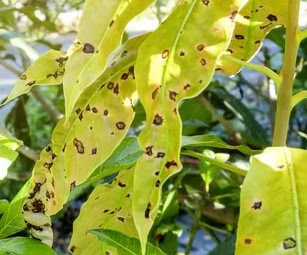
The symptoms of mango scab vary depending on the age of the infected tissue and the severity of the infection. On leaves, the disease first appears as tiny dark or black spots. As these lesions enlarge, the leaves may become distorted, curled, or crinkled. Corky growths can also develop on the underside of leaves, and severe infections may cause premature leaf drop. Defoliation weakens the tree and reduces its ability to produce healthy fruit.

Fruit symptoms are often the most economically damaging. Infected mangoes develop rough, corky, and scab-like lesions on their skin. These blemishes may crack as the fruit grows, producing scar tissue that reduces the fruit’s appearance and commercial value. In severe cases, infected fruits may fall from the tree before ripening. Even when the flesh inside remains edible, consumers are less likely to purchase blemished fruit, leading to financial losses for growers and exporters.

Mango scab can also affect young stems and twigs. Grey or brown lesions may appear on tender shoots, eventually becoming corky and enlarged. Heavy infections can slow shoot growth and reduce tree vigor over time.

Managing mango scab requires an integrated approach. Farmers often improve air circulation within orchards through pruning, which helps leaves and fruit dry more quickly after rain. Removing infected plant material can also reduce sources of fungal spores. Fungicide sprays, especially copper-based products, are commonly used during flowering and early fruit development when trees are most susceptible. In addition, planting resistant or less susceptible mango varieties can help limit disease outbreaks.

Although mango scab is sometimes overshadowed by other mango diseases, it remains a serious challenge in humid growing regions. Effective disease monitoring and proper orchard management are essential to maintaining healthy trees and producing high-quality mangoes for local and international markets.
Mango Scab: A Hidden Threat to Mango Production

Wednesday, November 20, 2024

Mango Floral Malformation: Issues and Management Approaches

Floral malformation in mango is a widespread issue that severely impacts mango production worldwide. This disorder is primarily attributed to the fungal pathogen Fusarium mangiferae, which disrupts the normal development of the mango inflorescence, leading to lower fruit yield and quality. Symptoms of floral malformation include the formation of compact, overcrowded panicles with large, often sterile or abortive flowers. These malformed inflorescences not only reduce the potential fruit-bearing capacity of the tree but also act as a significant source of spores, facilitating the spread of the disease to neighboring trees.

The complexity of the disease's etiology makes it particularly challenging to manage. Several environmental factors contribute to its spread, including excessive soil moisture, high humidity, and lower temperatures during flowering. Additionally, trees with high carbohydrate concentrations in their shoots and inflorescences are more susceptible to infection. The pathogen spreads efficiently through infected plant material, highlighting the importance of using disease-free seedlings and maintaining strict orchard hygiene to prevent new infections.

Efforts to control floral malformation often involve a combination of strategies. Pruning affected inflorescences can help reduce the spread of the pathogen and minimize its impact on fruit production. Fungicides may also be used, although their effectiveness is limited by the fungus's ability to develop resistance over time. Furthermore, plant growth regulators, such as paclobutrazol, have shown promise in reducing the severity of the disorder by altering the plant's growth patterns and decreasing susceptibility to fungal infections. However, these interventions must be timely and carefully managed to be effective.

Despite these measures, floral malformation remains a persistent challenge for mango growers. Ongoing research into more resistant mango varieties, better fungicides, and integrated management practices is essential. The development of resistant cultivars and the adoption of precision agriculture techniques may offer more sustainable solutions for controlling this debilitating disease.
Mango Floral Malformation: Issues and Management Approaches

Monday, April 29, 2024

Understanding Mango Gummosis Disease

Gummosis, also known as gumming syndrome, is a significant concern affecting commercially important fruit trees like mango crops and Prunus spp. This condition involves the exudation of gum in response to various injuries, leading to substantial losses in fruit production and sometimes tree mortality.

The causes of gummosis are diverse, including environmental stress, mechanical wounds, and infestations by pests or pathogens. For instance, Cytospora canker is a fungal disease commonly associated with gummosis in mango trees. Infected trees exhibit symptoms such as yellowing or wilting of new shoots and leaves. Sunken lesions develop on the bark, from which amber-colored, gummy sap oozes. As the disease progresses, curly orange fungal threads may emerge from the bark, and leaves often brown and drop prematurely.

The impact of gummosis on mango orchards can be devastating, with yield losses ranging from 30% to 100% in severe cases. Infected trees exhibit abundant gum secretion from branches, stems, and the main trunk, alongside vascular discoloration. In the worst instances, entire mango trees may succumb to the disease.

Efforts to manage mango gummosis include maintaining orchard hygiene, promptly pruning and disposing of infected plant material, and applying appropriate fungicides. Research into resistant cultivars and sustainable farming practices continues to be vital in mitigating the economic and ecological impacts of this widespread fruit tree disease.
Understanding Mango Gummosis Disease

Tuesday, February 1, 2022

Phoma blight of mango

The symptoms of a phoma blight infection are visible only on older leaves. When the fungus first attacks the leaves, symptoms show as small, discolored yellowish and brownish spots. Affected leaves display angular, yellow to brown irregular lesions scattered over the entire lamina.

As the fungal spores continue to develop, the spotting grows in size and area, with the coloration changing to a rusty brown and the centers can take on a grayish color. As the lesions enlarge their colour changes from brown to cinnamon.

Phoma blight spreads rapidly, and any health part of a plant that is touching infected soil is at risk of succumbing.

The symptoms are cause by the fungus Peyronellaea glomerata, formally known as phoma glomerata, thereby the common name of the disease. Phoma glomerata was originally described as a Coniothyrium by Corda. Woolenweber and Hochapfel transferred it to the genus Phoma and added the description for dictyospores. The species of sect. Peyronellaea are characterized by the production of conspicuous multicellular chlamydospores.

Infections by this fungus are most common in wet and cool conditions. It survives in soil and in the old plant debris that is under your plantings.
Phoma blight of mango

Friday, December 3, 2021

What are the symptoms of mango malformation disease?

Mango malformation disease (MMD) caused by Fusarium mangiferae severely affects the crop and is widely distributed in almost all mango-growing regions worldwide. Additional Fusarium species have also been reported to cause MMD.

It has become one of the most widely distributed threatening problems in mango growing orchards in India as well as in many other mango growing countries of the world.

Abnormal, compact development of shoots and flowers are common signs of mango malformation disease. There are two categories of symptoms. vegetative and floral malformation.

Vegetative malformation is most serious on seedlings and young trees in nurseries, especially where seedlings are grown beneath the canopies of affected trees, but it also occurs on mature trees.

Both normal growth and mango malformation disease–affected growth may be present on a plant at the same time. This includes shorter internodes, dwarfed malformed leaves and an overall tightly bunched appearance of the shoot, while inflorescence malformation includes short, thick and branched axes of the inflorescence.

The symptoms of floral malformation are characterized by deformation of panicles. suppression of apical dominance, shortening of primary and secondary axis. giving the panicle a characteristic clustered appearance, thickened rachis of panicles, and greatly enlarged flowers with large disc and the preponderance of staminate flowers bearing scantly pollen grains.

Floral malformation is most important economically since affected inflorescences usually do not set fruit.
What are the symptoms of mango malformation disease?

Thursday, April 10, 2008

Mango Malformation Disease (MMD)

Mango Malformation Disease (MMD)
Mango Malformation Disease is a fungal disease of mangoes caused by several species of Fusarium, some yet to be described. Mango is only known host of the disease.

The disease spreads on a tree very slowly, but if left unchecked, can severely reduce yields. The main method of spreading MMD to new areas is through infected vegetative planting material. There is no evidence that the disease can spread on fruit or the seeds, or that it affects human health. It usually associated with the bud mite, Aceria mangiferae but the mites have been shown to spread the disease within a tree and not between trees.

Mango Malformation Disease has been found on most mango growing countries of the world. Australia was thought to be free of the disease but in November 2007, symptoms of MMD were detected on treed in a finalized research trial containing about 2,000 trees at Coastal Plains Research Farm at Middle Point.
Mango Malformation Disease (MMD)

Popular Posts

FOOD SCIENCE AND HUMAN NUTRITION

FOOD PACKAGING TECHNOLOGY

COMPUTER SYSTEM